Key points
- The group type controls the order people ring in, not who is in the group.
- Members on do-not-disturb, on a call or logged out are skipped.
- If one person gets every call, the group is probably sequential.
- Out of hours, night service can send the group's calls somewhere else.
The four hunt group types
All four ring the same members. They only differ in who rings first and what happens next.
Collective
Every available member rings together. The first to answer takes the call.
Best for: reception and small teams where speed matters most.Sequential
Always starts at the top of the list and works down.
Best for: one main person, with others as backup.Rotary
Starts with the person after whoever answered the last call.
Best for: sharing calls evenly.Longest waiting
Starts with whoever has been free the longest.
Best for: busy sales or support teams.Side by side
| Type | Who rings first | Shares calls evenly? | Common surprise |
|---|---|---|---|
| Collective | Everyone available | No: fastest hands win | Phones on DND are silently skipped |
| Sequential | The first member | No | The first person gets almost every call |
| Rotary | The next after the last answerer | Yes | Feels random to staff |
| Longest waiting | The longest-idle member | Yes, by workload | Busy people seem to be skipped |
Which type should you use?
When a hunt group misbehaves
The usual causes are a member's status, the group's mode, or the route that sends calls to it.
The right person never rings
Check they're still a member, not on do-not-disturb, and logged in to a phone if you use hot desking.
Calls go somewhere else after hours
The group may be in night service, or a time profile may switch it. Check the group's mode and fallback.
External calls reach the wrong group
The incoming call route may point at another group or use its fallback. Use the fault finder
How the four hunt group types ring
Press a step to jump to it. Save the GIF to share it.
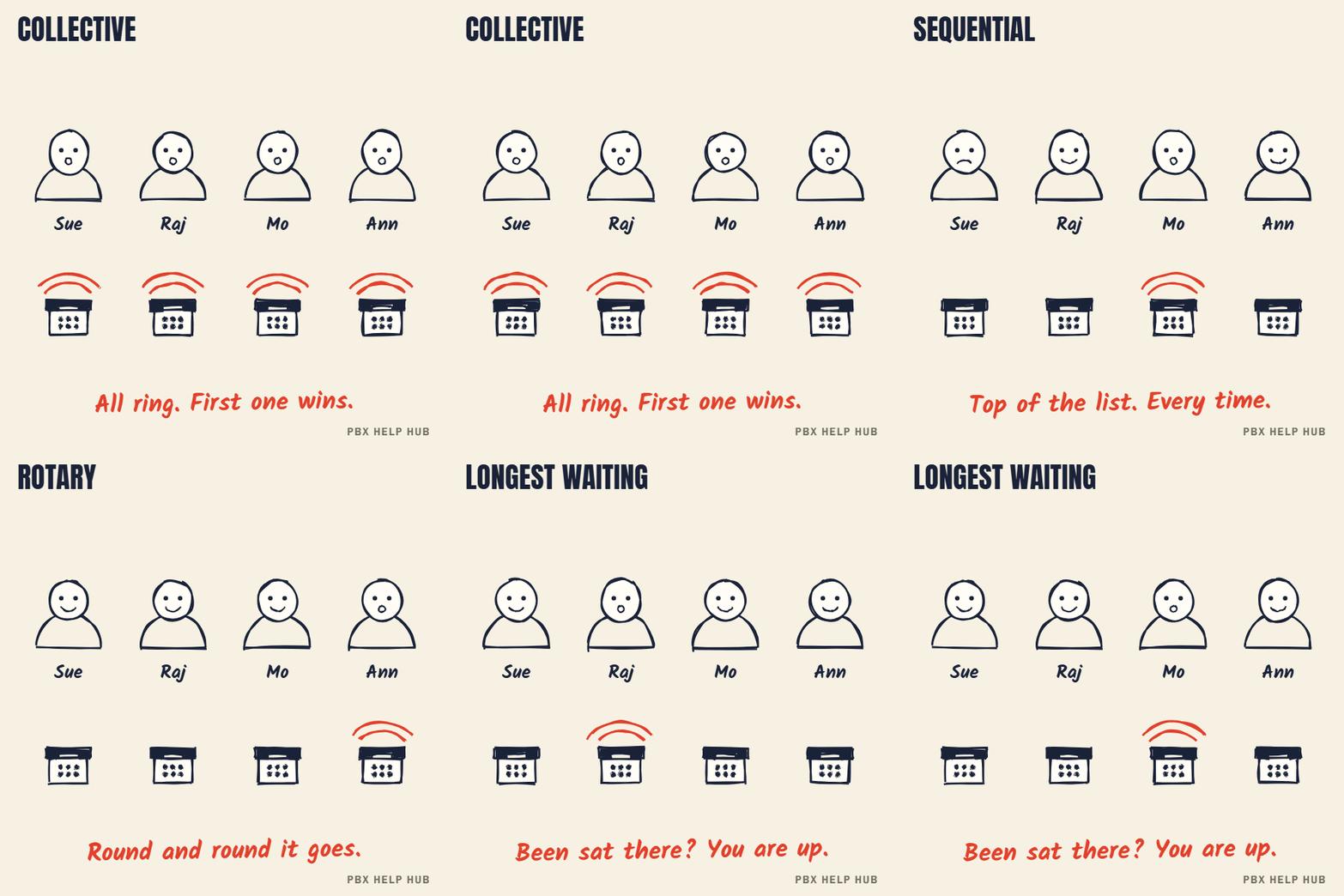
Hunt group types at a glance
Click a number to find out more. Save the image to print it or pin it.

Questions people ask
What is a hunt group?
A hunt group is a set of phones that share incoming calls, ringing in a chosen pattern so a team can answer calls to one number.
What is a circular hunt group?
Another name for rotary: each call starts with the person after whoever took the last one, so calls spread evenly around the team.
What is a hunt group number?
The internal number that reaches the whole group. An outside number can be routed to it, and colleagues can dial it directly.
What is the difference between a call pickup group and a hunt group?
A hunt group rings members automatically. A call pickup group lets colleagues answer a phone that is already ringing nearby, usually with a key or short code.
Can one person be in more than one hunt group?
Yes. Each group rings them by its own rules, so someone in several groups gets calls from all of them.
Why does a member on do-not-disturb still get some calls?
Some calls bypass the group, such as calls dialled straight to their extension, or numbers they've set as exceptions.
What happens when nobody answers?
After the group's no-answer time, the call moves to its overflow, voicemail or fallback, depending on how the group is set up.
Will changing the type drop calls in progress?
Plan changes outside busy hours, back up the configuration first, and change one setting at a time.
Related guides
Calls not reaching the right people
Open ↗Time profiles and night service
In reviewIncoming call routes
In review
Hunt groups are stage 4 of 6. Save the whole call path for the office wall or your maintainer.
Save image (PNG)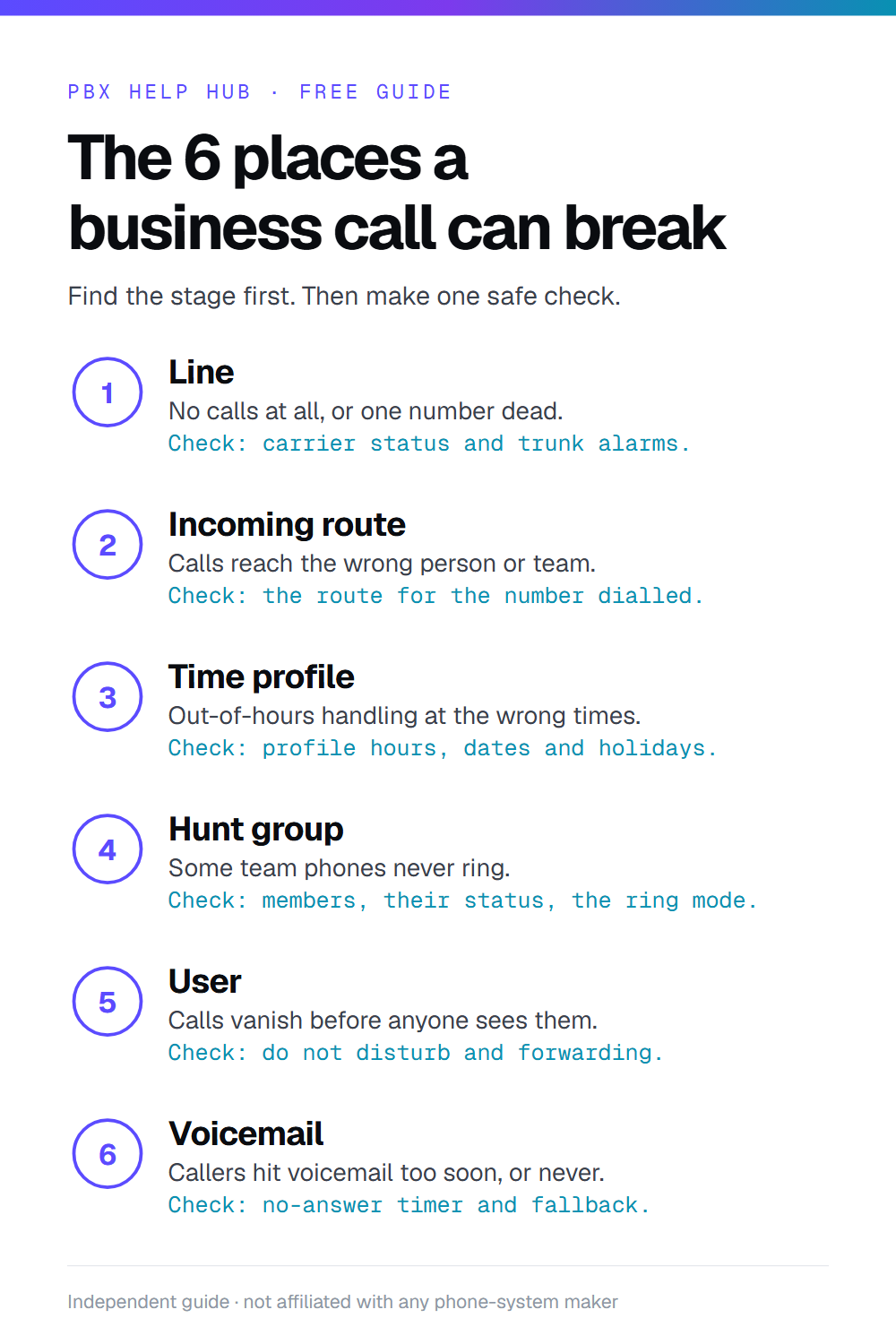
Want someone to check your setup?
Send us your hunt group and routing details and we can suggest the safest fix.