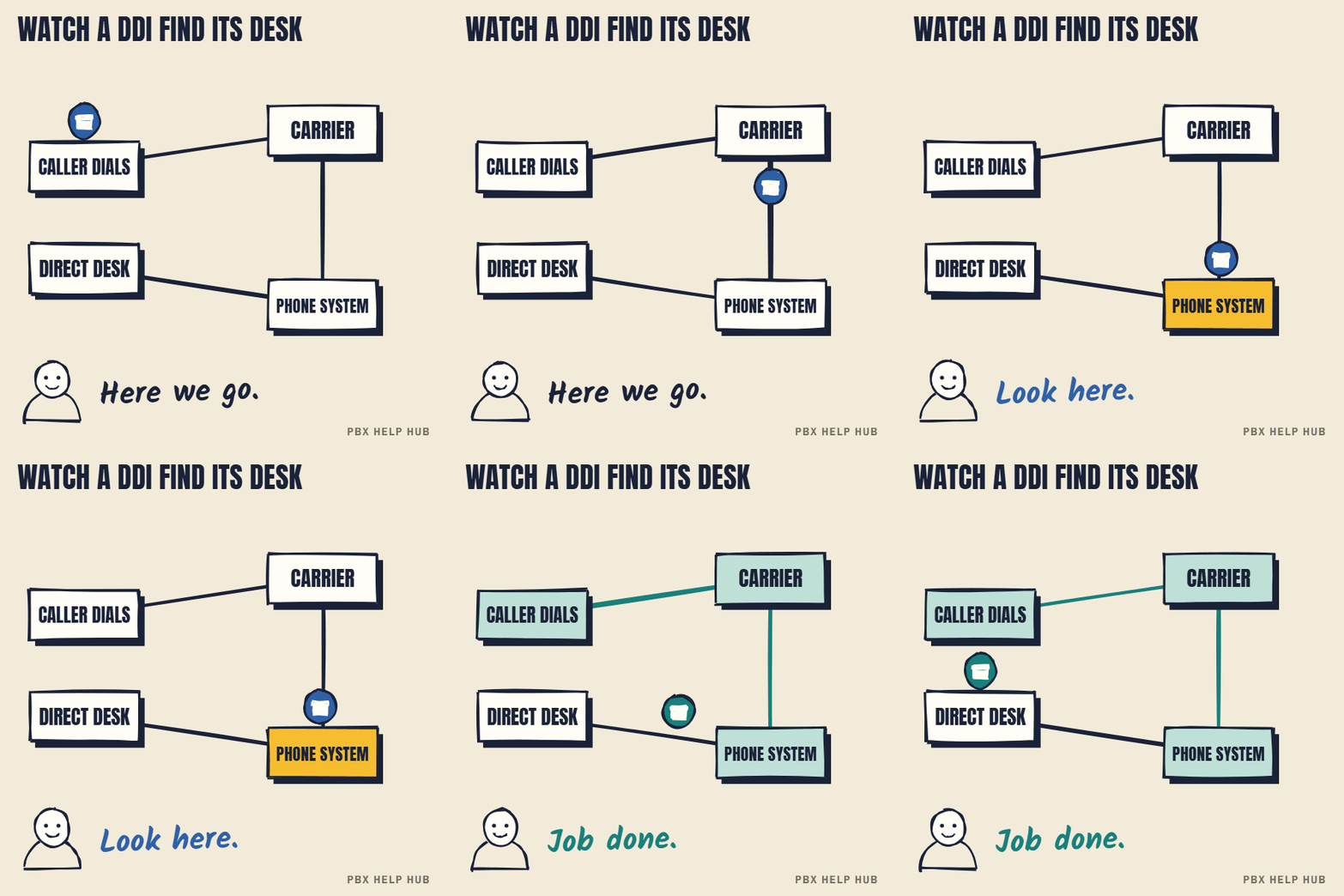
How the system uses it
When a call arrives, the carrier passes on the number the caller dialled. The phone system compares it with its list of incoming call routes and sends the call to the matching destination. That's why a DDI that "rings the wrong person" is almost always a routing question, not a phone problem.
Why digits matter
Carriers don't always send the full number. Some send the last few digits, some the full national number, some with a leading 0 and some without. If a route expects one format and the carrier sends another, the call won't match and falls to the catch-all. This often happens after a move to SIP or a change of carrier.
DID (direct inward dialling) in the US, and sometimes "direct line" or "extension number" in everyday use.
DDI ranges and how they're sold
UK businesses usually get DDI numbers in blocks, such as 10, 100 or 1,000 consecutive numbers, from their line provider. A block makes it easy to give each person or team their own number while keeping one main number for reception. When you change provider, the whole block can normally be ported, but check every number is included before you sign.
DDI, main number and extension: the difference
| Term | What it is | Who dials it |
|---|---|---|
| Main number | The number on your website and letterhead | Customers |
| DDI | A direct number for a person, team or menu | Customers who know who they want |
| Extension | A short internal number, e.g. 201 | Colleagues inside the building |
A DDI usually ends in the same digits as the person's extension, which makes them easy to remember, but that's a convention, not a rule.
What happens when a DDI isn't routed
A DDI with no matching route usually falls through to a catch-all, often reception, so unrouted numbers can go unnoticed. That's how numbers for leavers or old campaigns keep ringing reception for years. Review your DDI list once a year: remove numbers you don't need, and route the ones you keep on purpose. See Incoming call routes: how matching and fallback work.
Your DDI checklist
- Get a full list of your numbers from your provider.
- Write down where each number should go, by day and at night.
- Call each number and note where it actually lands.
- Mark numbers that land on the catch-all by accident.
- Decide which to route, and which to stop paying for.
Common questions
What does DDI stand for?
Direct dial-in: a number that reaches a person, team or menu without going through reception.
Is DDI the same as DID?
Yes, in practice. DID (direct inward dialling) is the US term for the same idea.
How many DDIs can one line carry?
Many. A single SIP trunk or ISDN line can carry a whole range of numbers.
Why does my DDI ring the wrong phone?
Usually the incoming call route for that number, or the digits the carrier now sends, don't match what the system expects.
What is a DID in telecom?
A direct inward dialling number: the US term for what the UK usually calls a DDI. It reaches a person, team or menu directly.
Can you give a DDI number example?
If your main number is 01632 960000, you might also hold 01632 960100 to 960199, with 01632 960123 ringing one person directly. These are fictional numbers used for illustration.
Sources
Last checked 9 November 2026 against the sources listed here. Menus and defaults can differ by software release, so confirm them on your own system. Spotted a mistake? Tell us.